Kimura told me to choose freedom
Oil on Paper
Spring, 2024
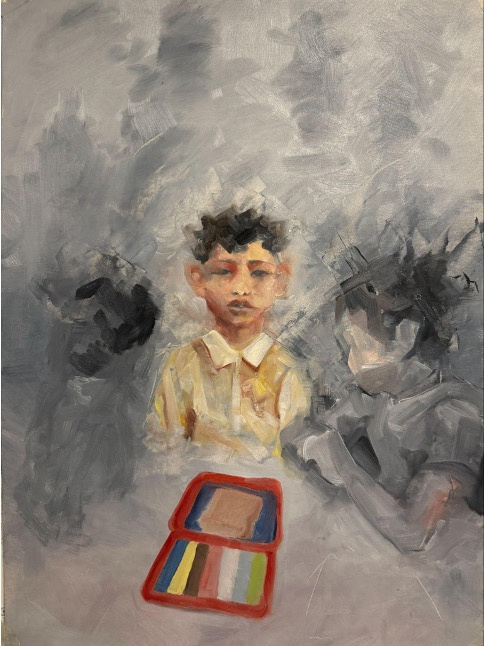
I began this painting wanting to “fix” Asian-American representation. In this stage my goal was to find a way to love the Asian figure on the page, because I felt that if I could love him I could find a way to love myself; to love what I feel this “culture of domination” wants so much for me to hate. So much of how double consciousness is depicted is an internal battle, because it is one, but through this piece I wanted to dissect what that looks like as a visual metaphor externalized through the eyes of an Asian-American child.
In this stage I made the central figure beautiful, pure (as depicted through the warmth in the figure that contrasts with the cool in the backdrop and the other figures), and confused. I wanted to depict a choice in his expression to choose for himself if he would accept his “place” as an Asian-American or to practice self-love. In this instance, it isn’t so much about if he chooses to succumb to white adjacency or not. At the end of the day, at least the choice would be his own. I wanted to depict a choice I wish I had. Through this painting is how I feel that I can experience my own choice. To me, choice is what grants freedom.
At this stage, I feel that something is missing, although I’m not quite sure what yet.
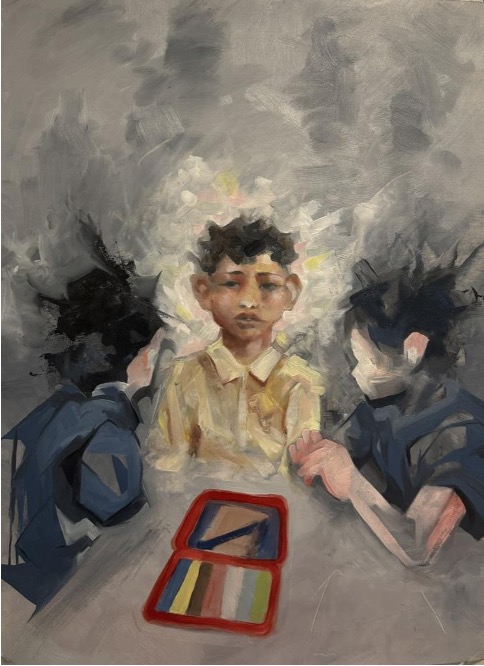
At this point in the painting I grew concerned with what I considered to be this “culture of domination”. I felt that I wasn’t necessarily always fair to place blame on the outer figures for the choice the Asian-American has to make. In the next stage I contemplated humanizing the outer figures, giving them more flesh toned skin, illuminating their faces, and bringing more life to them. For me the reality was that these people were still people, they weren’t fairy tale monsters. I think in a way I felt like they were also being, maybe subconsciously, controlled by this system. This outer group has more privilege of course, but controlled and manipulated under white supremacy nonetheless .
Much to my dismay however, it seemed that the more I brought life to these outer characters the more the Asian-American faded into the gray. It seemed to me that maybe he wanted to hide, or maybe it was that he was forced to become invisible. In any case, to combat this problem, I resorted to illuminating the area around the central figure’s head.
This solution ended up taking me one step further, and two steps back. In illuminating the area around his head, yes, it is true that the asian is more in focus. The new problem was that I did not anticipate that it would make him appear darker, thus creating a very metaphorical contradiction. He is now both hypervisible (because he is in focus) but now simultaneously invisible (because he has the illusion of being a more similar color to the background). At this point it appears that what I have illustrated is a literal and figurative depiction of color blindness.
I was fucking livid. In an attempt to “fix” my own representation, with all the care I put into depicting the central Asian-American figure, with all the research I’d done in an attempt to decolonize my mind, it all felt hopeless, it feels hopeless. I was universalizing my pain and thus, invalidating my experiences. I was making the mistake I’d been making my entire life; time and time again falling into the alienating and manipulative arms of white adjacency.
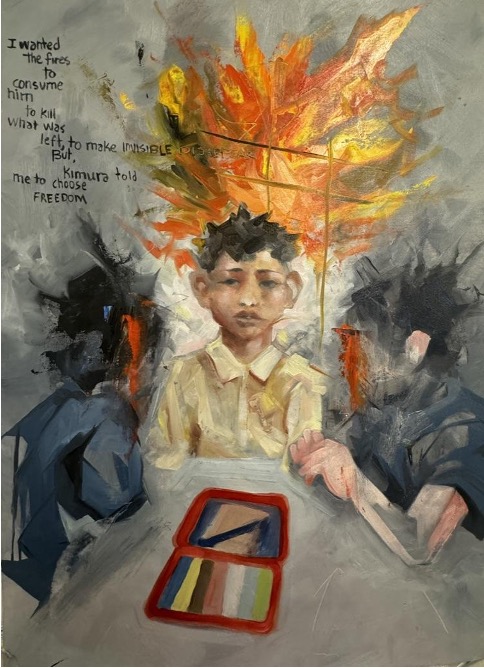
About a month ago now, I had the privilege of meeting with Korea-born, Belgium-raised, Activist and Artist, Kimura Byol. I asked him how to free yourself from double consciousness, more specifically, how to feel “korean enough”, and how to find belonging in a country that wants to dominate you. He told me that the only way to be happy in a world that doesn’t want to accept you is to “choose freedom”. To be honest, I’m still not fully sure what that means and I can’t really explain what it even is, but I know that I need it. I knew that for this piece, and for my life this is what I wanted to find. This is the key. I inscribed this into the side of the piece to remind myself why I was creating it in the first place: to find freedom.
When I was at this stage of the piece, I was still angry, I hated them for taking so much from me. I hated them for manipulating me, taking advantage of me. But what’s worse is I hated myself. I thought of every moment I thought “I just wish I could be treated white”. I thought about how hard I tried to force that square peg into that triangle hole only to realize too late that on the other end of that hole lies racial abstraction.
At this point the painting began to feel like a mystery that I would never solve. Every time I got to the other end of the hill, it felt like there was a mountain. I took it out on the page. What I had been feeling was a contradiction. I felt both invisible (my true identity abstracted), and hypervisible (as a minority) simultaneously. Because of this, I decided to invoke the flames of the 92’ LA Uprising in Koreatown. I decided on this symbol because I believe that it invokes a moment in which Asian-Americans are hyper visible and invisible simultaneously. The LA Uprising for me represents a moment in which the racial imaginary was pushed to its limits. Many Korean-Americans faced an impossible predicament. Much of the Korean community felt sympathy for Sun-ja Du, as they could imagine themselves or their parents working that job and what constant state of fear or anxiety would bring them to do something monstrous. Many fell victim to white adjacency, and saw black people for what the media and white supremacy told them they were: forever criminals. For many Korean-Americans, to do the right thing meant to reject a monster splayed on millions of television screens across America (one of the few times Asian-Americans were hypervisible), a monster that looked just like me. To do the right thing meant to be a race traitor. For me it often feels like to be Korean-American means to constantly feel like there is no home; not in white, black, or even other Koreans.
To quote Korean-American writer Julia Lee, “I felt my marginalization, my invisibility, my powerlessness. I wanted to light it all on fire, burn it all to the ground”.
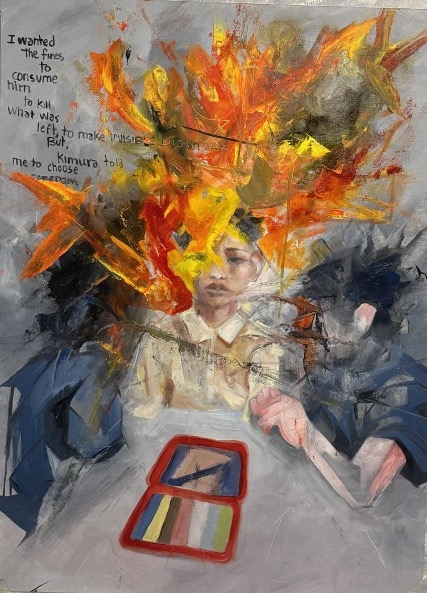
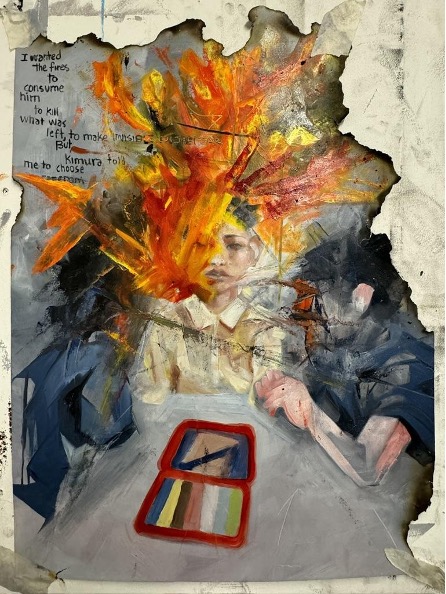
My rage consumed me and quite literally almost consumed the entire piece itself. In attacking the page with flames, and slicing it with a palette knife, I noticed that more and more the flames consumed the figure in the middle. Perhaps more significantly, it began to obscure the word “freedom” in the left corner of the page. I realized at that moment that my anger wasn’t solving anything. I was suffering from Hegelian alienation. When I started I viewed myself through the eyes of white supremacy. So I thought that If I went in the exact opposite direction, I could find freedom. I thought that from that point on, I would vehemently reject this culture of dominance; I would hate white people, and maybe then I would be free. I had based my new identity on contrarianism, and confused it for freedom. This still wasn’t my choice, this was a choice that was dictated by a domination over my identity. This was a new double consciousness. This was essentially the same problem in a different form.
 Haneul Conner