I just wanted to feel human.
Oil on paper
Fall, 2023
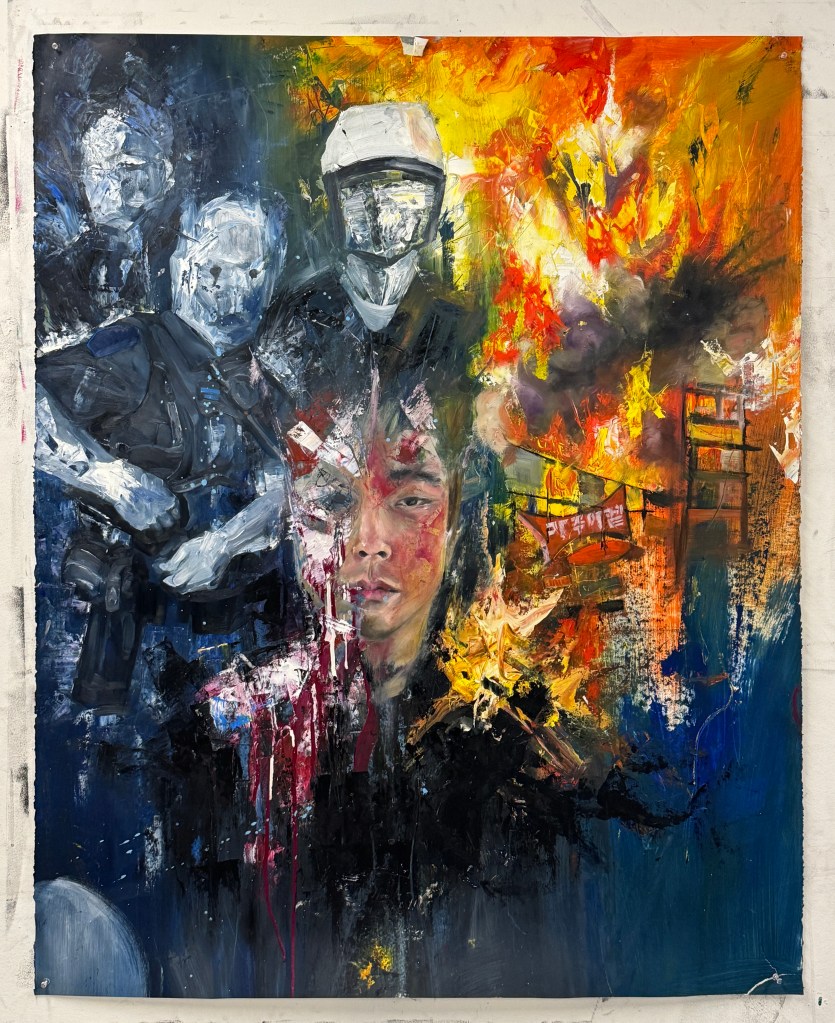
Positionality Statement on Being Korean American in 2025
It seems to me that the older I get, the more nuanced and complicated my answer to this question becomes. I’ve always believed my positionality to be eternally fused to my identity. I spent my whole life never even considering the possibility of these two being separate concepts. In my childhood, I was a military kid, which meant I moved every two years or so. I’ve lived all around the east coast mostly in white suburban areas. In retrospect, I never felt that I got the opportunity to set roots anywhere and figure out who I am from and where I belong. So I tried to change myself; how I dressed, what I ate, how I spoke to my mom. It’s the Asian-immigrant story; if only my face could be less flat, if only I could have different shaped eyes, if only I could be more white. It took a lot of time before I could realize that it wasn’t whiteness that I wanted so badly, it was just a bit of humanity. As I got older, still not learning my lesson, I went in the opposite direction. I resented white people for what I felt that they’d done to me, what I felt that they’d taken from me. It was vengeance, and it didn’t really make me feel less alone. In fact, it it was the opposite, it led to self-negation. I spent my life to that point acting on compulsion; it seems that people want me this way so let me become that. Only to respond with another act of compulsion, the entire time telling myself that my choice to blindly hate was just that, MY true choice that I was making for myself.
Growing up, every time I went to Korea, my relatives would ask me the same question, “미국 이 좋아 한국 이 좋아?”
“Do you like living in America or Korea better?”
I know that they didn’t mean anything by it, but this question always made me uncomfortable because it felt like they were asking which part of myself I liked better. I’ve always described myself as Korean-American but I don’t think I’ve ever felt comfortable with that. I never felt like the I was like the other Korean-Americans I knew. But I never really felt like the Koreans I knew either. It was hard to connect with them because the constant moving created a language barrier.
After defining myself like that for a while I changed my identification to Korean/Korean-American. After a certain point it began to feel arbitrary. How could three words possibly encapsulate my entire being? Why should I be expected to define myself in this way? When I realized this, it felt like for the first time in my life I could see the distance in between my identity and my positionality.
I think I would still define myself as Korean-American, but I would remove the hyphen. To me, it always seemed that that was the defining marker of that label. It sort of represents the bridge between these two identifications. Without the hyphen it’s absence but also presence. I’m not Korean, I’m not American, I’m not the bridge between these two worlds, and yet, I am all of those things. I want to live in the space beyond identification, that is my choice.
Positionality Statement on Being Korean-American in 2023
I’ve always held that my position in the world was and is a bit unique. I am a Korean-American but, unlike most Korean-Americans, I’m also a military dependent with a dual citizenship.
When I was younger I struggled a lot with my identity. I moved every two years so I never really felt that I had that chance to develop like some of my other friends. I never really knew what it was like to have those lifelong friends and I never felt like I had that strong foundation that many kids with a “hometown” feel. I spent about half of my childhood in America, and I spent about half of my childhood in Korea, but only two years at a time. This made it hard to really fit in with Korean people because every time I moved back to America, I’d lose a bit of my Korean, making it hard to make friends, and in America, growing up I spent a lot of time around white people who have never seen an Asian before. From the “squinty eyes” to “chink”, I’ve probably heard everything. I had friends, but I remember two things very well: I vividly remember that I would always try to explain it; what it was like to have people look at you like you don’t belong everywhere you go, but the more I did that, the more I felt like they would never understand. In retrospect I think they just had no frame of reference. Little by little I gave up trying. I spent a lot of time by myself. At the time I think I just couldn’t understand why, I never felt any different than any of my friends, so why was I being treated like I was?
And It’s not had anyone to look up to growing up. The Asians I remember seeing were always one of three things: Doctor, Doctor, and freak-foreign-exchange student (I especially hated Sixteen Candles, the Aristrocats, and very abhorrent and completely unnecessary scenes in Breakfast at Tiffany’s). I think instead of being offended, I more just felt alone. I come from three generations of immigrants, and I came to a realization,
“I’m going through the same shit as my dad, and his mother, and even my own mother”
I had nothing to hold on to; no proof that my position would be any different. I felt like the world would see me as just that and only that: a foreigner.
As I got older I learned many things about my positionality. As I began to mature I really stopped caring. And when I say that I mean that I realized that I kept trying to contort myself into an impossible model minority stereotype. Why should I become what white people want me to be? Why should I want the approval of those who make me feel like an outcast? But more significantly, why have I melded my positionality with my personality? These impossible questions finally had an answer. My identity and my race are not mutually exclusive: they are who I am, and I take a lot of pride in that, but I feel like my identity is within me and not within the mouths of others. If all I do is be a good person, I think I’m doing okay.
 Haneul Conner